
Map a San Bernardino County People Search
The fastest route depends on the fact already known. A street address belongs first in the assessor's parcel system, not the recorder index. A deed party or document number belongs with the recorder. A court case number goes to the Superior Court. An old family name may call for probate, vital registers, or archived local sources. Each trail has a different keeper, and one portal rarely settles identity on its own.
Use a short, repeatable process. Save the exact spelling, date, parcel number, case number, or document number from every result. Then compare that fact in a second official system. Common names, trusts, joint owners, and changed surnames can otherwise join two different people by mistake.
- Write down the full name, spelling variants, likely city, and any date or old address already known.
- Use govPIMS for an address or possible owner, including its active, inactive, formatted, and unformatted name choices.
- Move an owner name into the Recorder's Index to locate transfers, liens, and document numbers.
- Check court, license, business, probate, or custody records only when the known facts point to that type of event.
- Order or view the underlying record before relying on an index entry.
Note: An index match is a lead, not proof that two records describe the same person.
San Bernardino County Records Desks
The Assessor-Recorder-County Clerk combines several county functions, but each function answers a distinct question. Recorder staff handle official documents and copies. The assessor identifies and values parcels. County clerk services include vital certificates, fictitious business names, notary-related filings, and other registrations. The Registrar of Voters controls election records, while the Superior Court keeps case files. General county requests use the California Public Records Act only when no specialized channel applies.
These contacts are useful when a San Bernardino County people search reaches a portal limit. The full rules for records requests, fees, exemptions, and copies belong in the San Bernardino County public records access overview.
Assessor-Recorder-County Clerk
222 West Hospitality Lane, 1st Floor
San Bernardino, CA 92415-0022
855-732-2575
Superior Court Case Access
District clerk offices
San Bernardino County, CA
909-481-4228 or 760-241-9529
Registrar of Voters
777 East Rialto Avenue
San Bernardino, CA 92415-0770
909-387-8300
San Bernardino County Property Search Trails
Property is the strongest official name-to-address route in San Bernardino County. govPIMS accepts a parcel number, a full or split address, or an owner name after its public-use disclaimer. Its report can show current owner data, mailing and property addresses, assessment history, parcel events, owner history, acquisition dates, and recorder document numbers. The situs address is the parcel location. A mailing address is where the owner receives mail, so the two may not match.
The govPIMS parcel search shows the map and search utilities used for this trail.
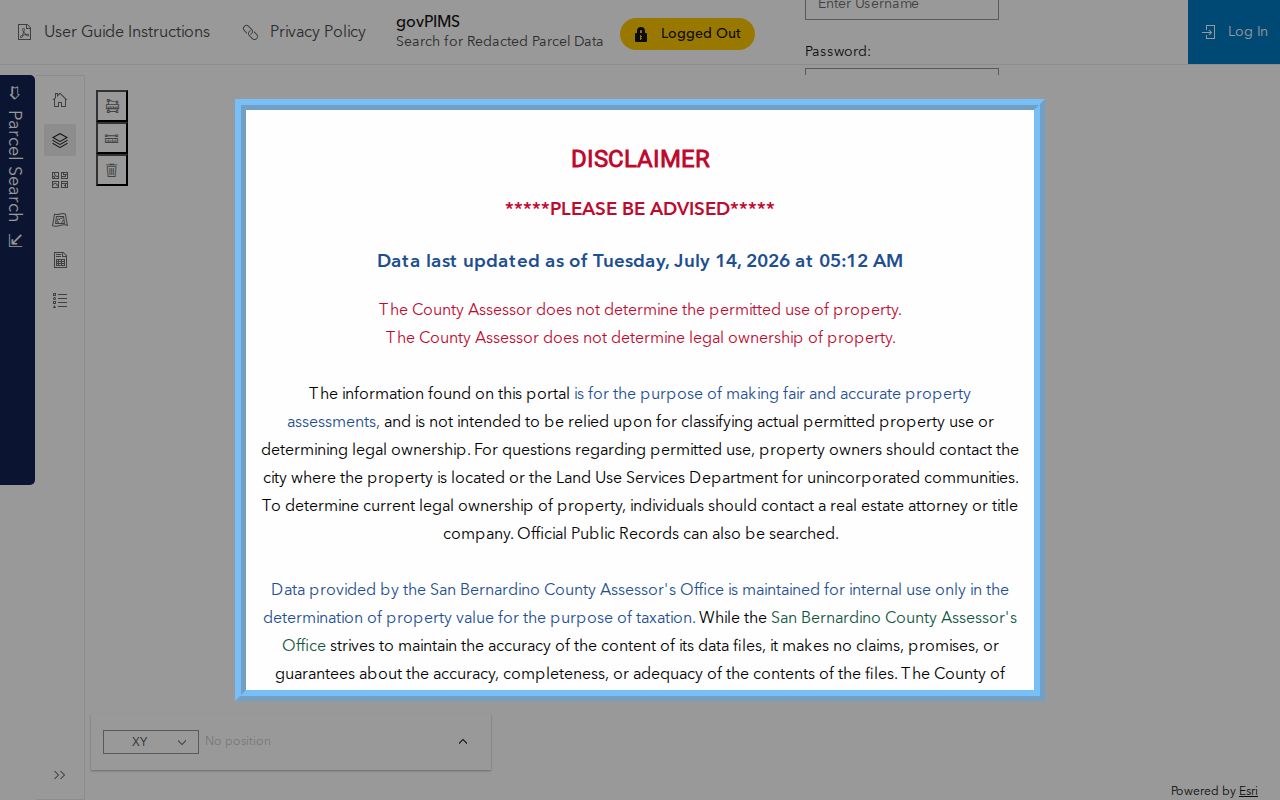
The screen matters because the name controls are easy to miss. Broaden a failed search from active to inactive names, then test formatted and unformatted versions before assuming the county has no match.
| govPIMS field | Entry type | How to use it |
|---|---|---|
| Parcel Number | Text | Direct parcel search |
| Address | Street and city | Find a parcel when the location is known |
| First Name | Optional text | Narrow a common surname |
| Last Name | Name text | Main owner-name field |
| Active / Inactive Names | Checkboxes | Move between current and past owner records |
| Formatted / Unformatted Name | Checkboxes | Test alternate storage formats |
San Bernardino County Recorder Name Index
The Recorder's Index is a catalog by party and document, not an address-owner search. It uses document number, date, title, grantor, and grantee. A grantor transfers an interest, while a grantee receives it. ARC says Document Search covers 1925 to the present, yet its chain-of-title instructions call 1958 to the present the practical grantor/grantee research range. Both statements matter. They describe related tools and workflows, not one clean promise of identical coverage.
The Recorder-County Clerk Public Access System begins with a disclaimer and captcha.
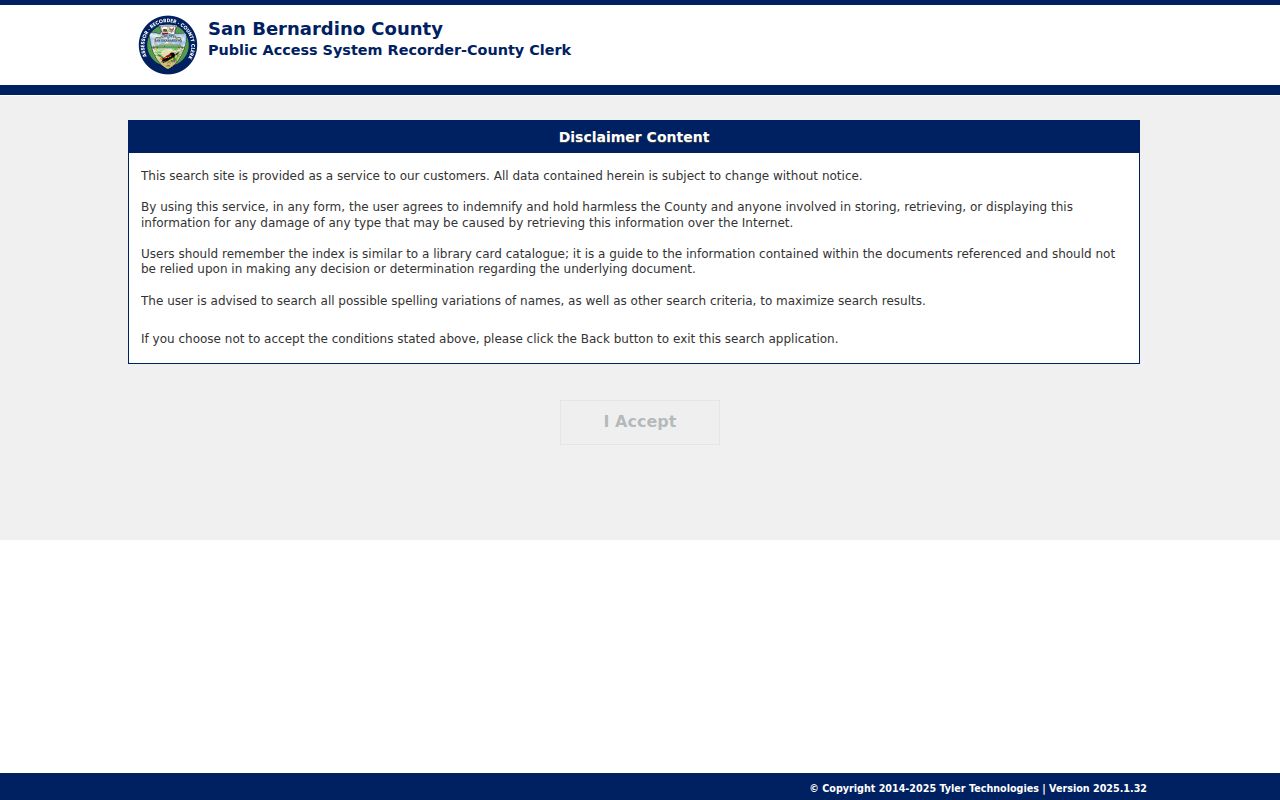
Actual document images are not displayed in the online index. ARC directs researchers to the Hall of Records or High Desert Government Center to view contents. The index screen helps separate a searchable name result from the underlying instrument.
Note: Search every plausible spelling and keep the legal description consistent as a deed trail moves back through prior owners.
San Bernardino County Official Record Copies
Once the index supplies a document number, copies can be ordered online or by mail. Online noncertified copies are emailed, while certified copies are shipped. Mail copy requests go to the Hospitality Lane office, and ARC says they should return within one to two weeks after receipt. An office visit remains the path for viewing document contents without relying on a remote image.
The ARC official records page lays out those copy and viewing channels.
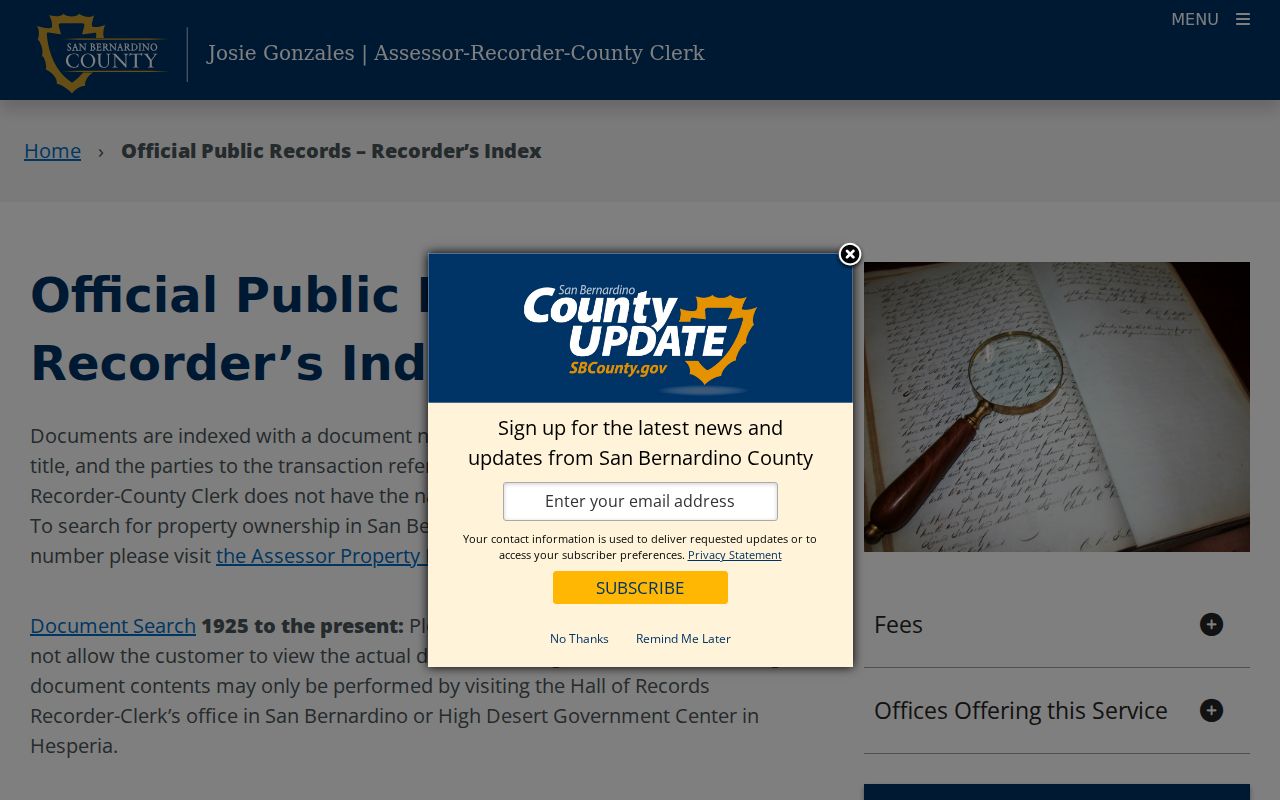
The source screen helps separate a free index result from the paid or in-person step needed to inspect the record itself.
- Index
- A catalog that points to a record but may not show its full contents.
- Grantor
- The party transferring a recorded interest.
- Grantee
- The party receiving a recorded interest.
- Certified copy
- An official copy bearing the custodian's certification.
San Bernardino County Court Lookup Routes
The Superior Court of California, County of San Bernardino uses the Court Access Portal, or CAP, for public case information, calendars, document viewing, and case payments. A docket is the running list of filings and court events in a case. Public entries may identify parties, a case number, filing dates, hearings, and documents. Some functions require an account, and the static portal does not expose every party-name field before login.
The San Bernardino Court Access Portal provides the official navigation shown here.
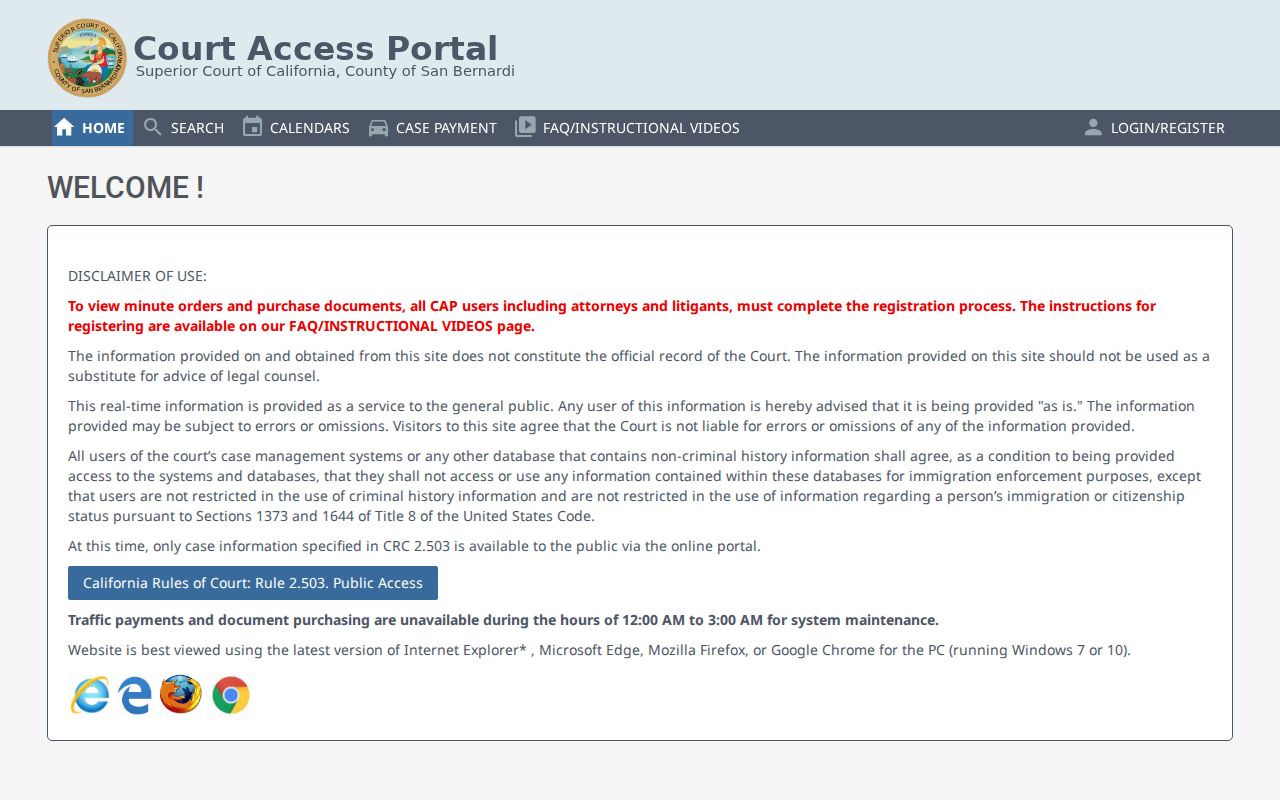
Public civil documents cost $0.50 per page through remote sales. Pre-1998 case data may be limited because the court is still converting paper files. Contact the district where an older case was filed or heard when CAP stops. Juvenile, sealed, adoption, and other confidential material stays restricted. Judicial administrative records use a separate Rule 10.500 request and cannot replace a case-file request.
| Record route | Best use | Limit or fallback |
|---|---|---|
| Superior Court CAP | Case information, calendars, public documents | Some access needs login; older data may be thin |
| Probate business office | Estates, trusts, guardianships, wills on deposit | Fontana and Victorville handle probate business |
| Court district clerk | Older or nonremote public files | Contact the district that held the case |
| Federal PACER | Central District of California dockets | Account and federal privacy rules apply |
San Bernardino County Vital Record Paths
The Recorder-County Clerk issues birth, death, and marriage certificates for events in San Bernardino County. California distinguishes authorized certified copies from informational copies. An informational copy can confirm facts but cannot establish identity. Authorized certified copies are limited to eligible applicants under state law. Divorce has two paths: the California Department of Public Health can issue a dissolution certificate, while the Superior Court holds the actual case, decree, and orders.
County requests may be made through the San Bernardino or Hesperia service locations or by mail. The county's mail form requires record details, applicant details, payment, and, when needed, an authorized-person declaration and notarized sworn statement. CDPH is the statewide fallback. County offices may be faster than the state office, whose captured average for certified-copy requests was five to seven weeks.
For family history, modern certificate rules are only half the story. County archive material starts marriages with San Bernardino County's formation in 1853. Birth and death registration began in 1873, and the archive describes the 1873 to 1910 material as register format. A register is an older ledger-style record, not a modern certificate request.
Note: A general public-records request is not the right route for birth, death, marriage, or divorce documents.
Heir Searches Across San Bernardino County
Estate and heir research works best as a chain of official facts. Start with a probate case or death record. Compare the decedent's name with co-owned property, recorded transfer documents, surviving-spouse affidavits, and an obituary or cemetery source. Probate petitions, notices, inventories, and creditor filings can connect relatives and addresses where the court makes them public. The Fontana and Victorville probate offices handle estates, trusts, conservatorships, guardianships, and related matters.
Unclaimed property supplies another careful lead. California holds lost or forgotten property until an owner or heir claims it, with no claim deadline or state claim fee. A result may connect a name with a reported address, holder, and property type. It does not by itself prove kinship. Compare it with probate, deed, and vital facts before using it in an estate trail.
The useful flow is: decedent name → probate case → parcel or deed → family and address links → unclaimed property. Adoption or birth-parent research requires official court and registry procedures because California does not treat those records as an open people index.
San Bernardino County Geography Shapes Search
San Bernardino County stretches from dense valley cities through mountain areas and High Desert communities to remote desert land. A postal place name does not always identify the government that holds a permit, complaint, or local record. Someone may receive mail under one community name, live on an unincorporated parcel, attend a school in another district, and use county services at a desert office rather than in the county seat.
Determine whether an address lies inside a city before seeking permits or code files. Cities keep their own planning and building records. County Land Use Services covers county jurisdiction. ARC states county building permits were not required until about 1936, and it says neither the Recorder nor County Historical Archives keeps those permits. Some cities began earlier. For a pre-1936 unincorporated property, deeds, assessment rolls, maps, newspapers, and directories may carry the trail when no permit can.
The two-counter design also matters. Recorder document images can be viewed at the Hall of Records in San Bernardino or the High Desert Government Center in Hesperia. That is a practical response to the county's size, not a second online database.
San Bernardino County Voter Record Limits
My Election Gateway is a self-service sign-in for the voter, not a casual search for someone else. It asks for a last name, the numeric part of the residence address, a birth date, and a captcha; a full first name may be needed when more than one match appears. After a valid match, the voter can see registration status, addresses, districts, voting history, ballot status, and other personal election tools. Voting history shows whether someone voted, never how a ballot was marked.
County voter files follow a different route. California permits access for election, scholarly, journalistic, political, or governmental purposes, with confidential voters excluded. A voter may buy a certified copy of their own application or a certified registration letter in person with identification. The complete record-specific rules are covered under San Bernardino County voter records.
Use records lawfully. Do not use any address, voter detail, court entry, or registry result to stalk, threaten, harass, or harm a person. Protected and confidential data must remain protected.
San Bernardino County Jail Record Lookups
The Sheriff's Inmate Locator handles current custody searches. Its direct form accepts either a ten-digit booking number or a combination of name, birth date, age, and gender. The public route can also show projected releases by date. The Sheriff's inmate locator page routes those searches and explains visiting access.
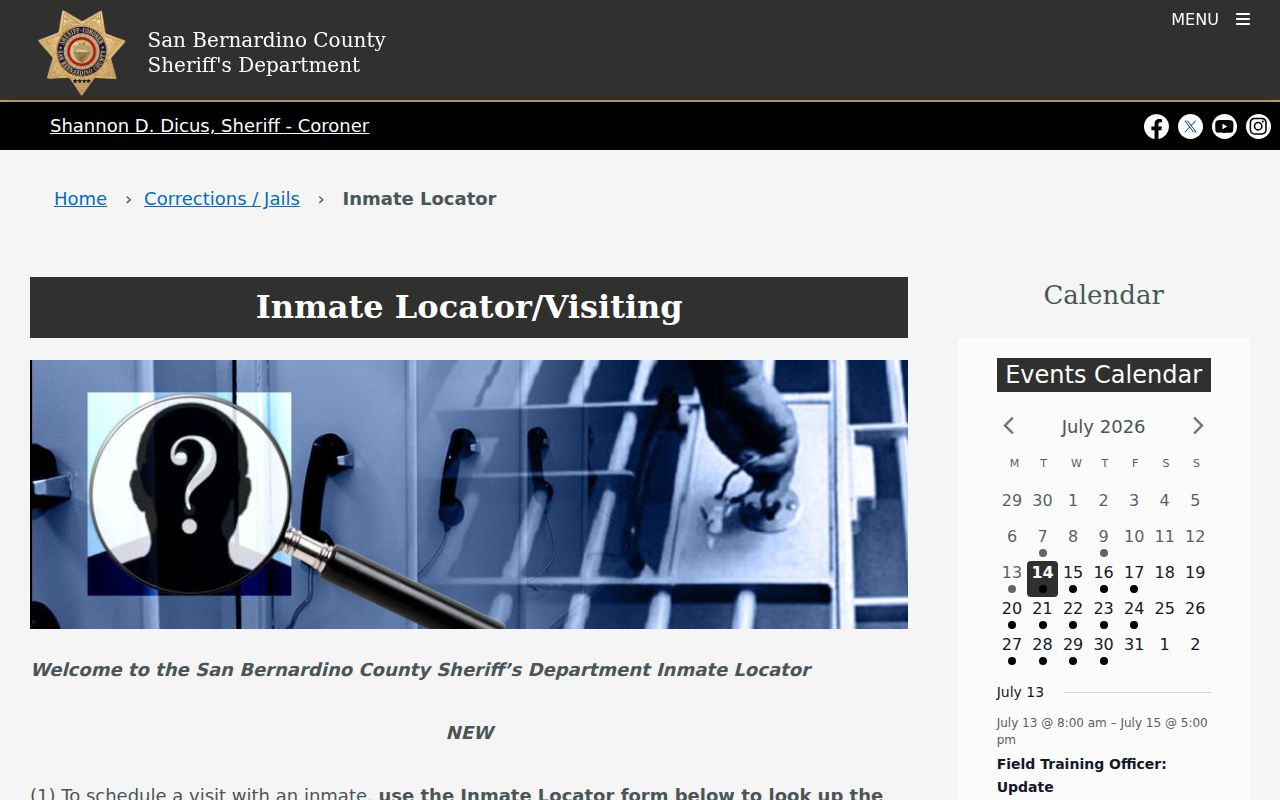
The portal is for current custody information, so confirm it instead of relying on a saved copy. Other Sheriff's records may require a verbal or written request. California's public safety registry is separate from jail records, and the California Megan's Law search opens with an official disclaimer.
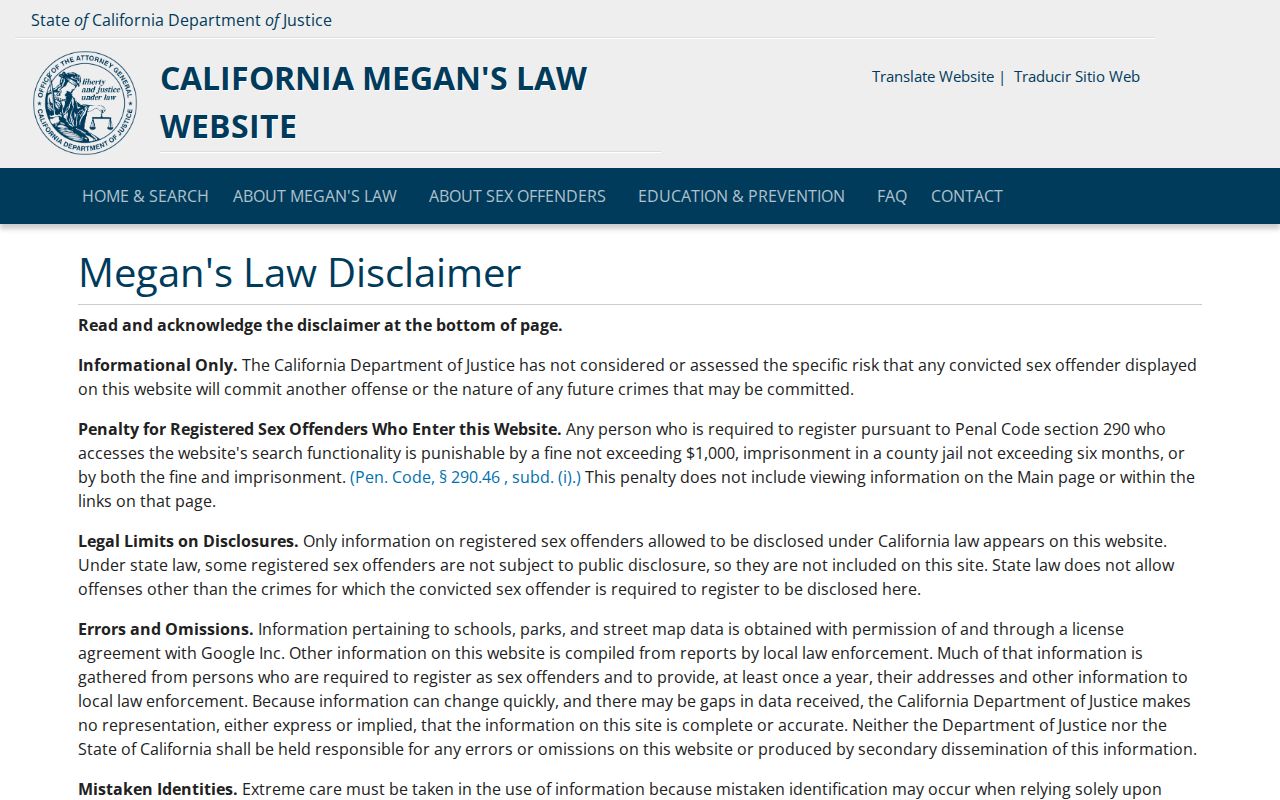
Registry information has strict anti-harassment limits. Treat it as a safety resource, not as permission to contact or target anyone listed.
Note: A booking record reflects a custody event and should not be presented as proof of guilt or final case outcome.
San Bernardino County License Search
California license and business systems can confirm a public work or ownership connection when county records point to a firm. The Department of Consumer Affairs search accepts first name, last name, license number, or business name, with board, bureau, license type, city, county, and status filters where available. Results may show whether a covered license is current, expired, suspended, or revoked. Some boards use their own sites, so an absent DCA result is not universal proof of no license.
The DCA advanced license search displays the filters available for a San Bernardino County name search.
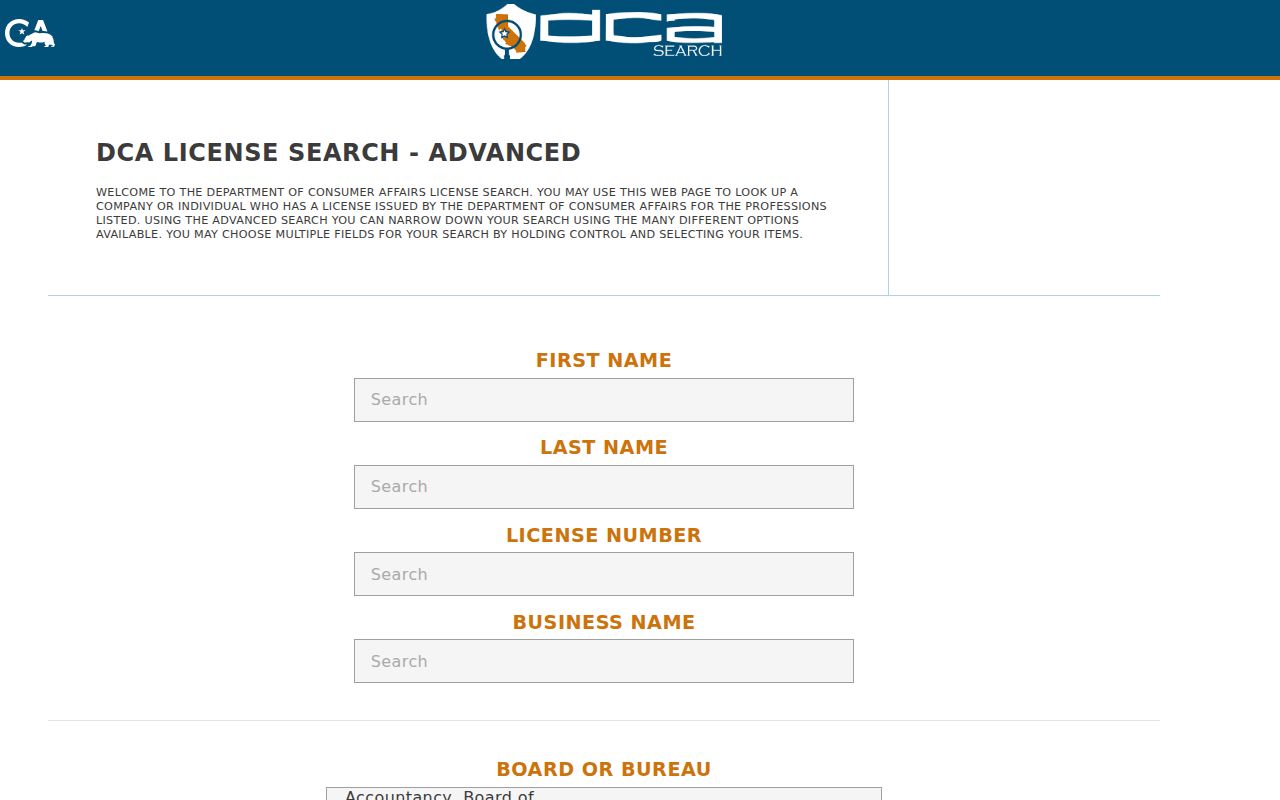
Use the license number and board name to distinguish people who share a name. A status is tied to that credential, not to every activity of the person.
San Bernardino County Business Filing Search
Business filings add a second statewide trail. They can connect a name with an entity, public agent, filing address, or document history. Search by the exact entity name first, then use an entity number when another record supplies one. County fictitious business names still remain a separate clerk record.
The California bizfile business search covers corporations, limited liability companies, and limited partnerships.
Public entity filings and images can show entity numbers, status, jurisdiction, agents, addresses, and filing history. Local fictitious business names remain with the county clerk, while UCC records use the Secretary of State's separate debtor, secured-party, or file-number search.
San Bernardino County Records Era Lines
Record coverage changes at several local dates. San Bernardino County formed in 1853, so older area marriages are found under Los Angeles County. State-required birth and death registration began in 1873. Those records stayed at county level until 1905, and local archive material from 1873 through 1910 remains in register form. Modern-looking search boxes do not erase these older filing boundaries.
Property, court, and permit sources have their own breaks. ARC lists official Document Search from 1925 forward, but names 1958 forward for its grantor/grantee chain method. County permits were not required until about 1936. CAP warns that case data before 1998 may be limited while paper records are converted. When a date falls before one of these lines, move from the portal to the archive, office counter, district clerk, or older record class.
For local-history work, city directories, newspapers, yearbooks, cemetery files, and the CSUSB local history guide may bridge a missing government index. Exact San Bernardino city-directory years were not confirmed on an official library holdings page, so verify the available run with the library before planning a visit.
San Bernardino County Portal Fallbacks
Every San Bernardino County people search needs a plan for a blocked captcha, a thin date range, or an index without images. Use the specialized copy form first. Recorder records can be viewed at two counters or ordered online and by mail. Older court files go to the district clerk. Vital records use county or CDPH forms. County agency records without a special process go through NextRequest under the California Public Records Act.
Official systems and commercial compilation services solve different problems. Official indexes are narrower, tied to a named custodian, and best for confirming a record. Commercial compilations combine many sources for convenience but may be stale, incomplete, or linked to the wrong person. Neither category turns a name match into proof. Only the custodian can provide the official record or a certified copy.
| Source type | Strength | Main caution |
|---|---|---|
| Official index | Direct custodian metadata | May omit images or older records |
| Certified copy | Official copy of the held record | Fees and eligibility may apply |
| Commercial compilation | Broad convenience search | Can be stale or mismatched |
Note: A California Public Records Act request receives a disclosure determination within ten calendar days, with a possible written extension for unusual circumstances.
San Bernardino County Official Source Check
Source verification became a local records issue in 2026. San Bernardino County warned that an unauthorized domain was copying the look of a past Assessor-Recorder-County Clerk site. The county identified arc.sbcounty.gov as its official ARC web address. A polished seal, familiar layout, or urgent copy offer is not enough. Confirm the domain from the county's main site before entering personal details or paying for a document.
Check the listed custodian, record description, date range, and fee against the official office page. Recorder copy prices provide a useful test for high-priced deed mailers: ARC lists $4 for the first page, $1.50 for each added page, and $1.50 per page for a certificate under seal. Online card orders add a 3.5 percent surcharge. A private offer may charge for convenience, but it should never be mistaken for the county office.
Keep the final result with its source URL, access date, and record number. Public records change. Court events advance, ownership transfers, licenses expire, and custody status shifts. A current official check protects the person being researched and the person relying on the answer.